In peer-reviewed journals
Frost-Karlsson, M., Zetterqvist, M., Olausson, H., Boehme, R. (2026) Attenuation of self-produced touch in the posterior insula reflects body image disturbances in anorexia nervosa. Scientific Reports 16, 29913.
Salamone, P. C., Dowzuk, N. A., Gallo, M. N., Boehme, R. (2026) Social touch is associated with disrupted bodily self-concept in people with depersonalization symptoms. Acta Psychologica 268, 107307
Boehme, R., Kaldewaij, R., Karlsson, M. F., Wold, A., Enmalm, A., Khoure, I., … & Zetterqvist, M. (2026). Theta burst stimulation of extrastriate body area for body perception in anorexia nervosa: A Randomized Controlled Trial. Translational Psychiatry, 16, 324.
Enmalm, A., Vagnoni, E., Falk, P., Fotopoulou, A., & Boehme, R. (2026). Predictability and Agency Shape Self-Touch Perception. Collabra: Psychology, 12(1), 160692.
Böhme, R. (2026). Von Körperschema bis Co-regulation. Nervenheilkunde, 45(05), 303-312.
Salamone, P. C., Enmalm, A., Kaldewaij, R., Åman, M., Medley, C., Pietrzak, M., … & Boehme, R. (2025). Altered processing of self-produced sensations in psychosis at cortical and spinal levels. Molecular Psychiatry, 1-10.
Enmalm, A., Nguyen, T., Boehme, R. (2025) Self-touch is different from giving and receiving touch simultaneously – insights from neural, behavioral, and physiological measures. IEEE Transactions on Affective Computing
Candia-Rivera, D., Boehme, R*., & Salamone, P. C.* (2024). Autonomic modulations to cardiac dynamics in response to affective touch: Differences between social touch and self-touch. IEEE Transactions on Affective Computing, 2025
Candia-Rivera, D., de Vico Fallani, F., Boehme, R*., & Salamone, P. C. *(2025). Linking heartbeats with the cortical network dynamics involved in self-social touch distinction. Communications Biology, 8(1), 52.
Frost-Karlsson, M., Capusan, A.J., Olausson, H., Boehme, R. (2024) Altered somatosensory processing in adult attention deficit hyperactivity disorder. BMC Psychiatry 24, 558
Maallo, A. M. S., Novembre, G., Kusztor, A., McIntyre, S., Israr, A., Gerling, G. J., … & Boehme, R. (2024). Primary somatosensory cortical processing in tactile communication. Philosophical Transactions of the Royal Society B, 379, 1908, Jul 15.
Kaldewaij, R., Salamone, P. C., Enmalm, A., Östman, L., Pietrzak, M., Karlsson, H., … & Boehme, R. (2024). Ketamine reduces the neural distinction between self-and other-produced affective touch: a randomized double-blind placebo-controlled study. Neuropsychopharmacology, 1-8.
Pietrzak, M., Yngve, A., Hamilton, J. P., Asratian, A., Gauffin, E., Löfberg, A., Gustavson S., Persson E., Capusan A.J., Leggio L., Perini I., Tinghög G., Heilig H., Boehme, R. (2024), Ghrelin decreases sensitivity to negative feedback and increases prediction-error related caudate activity in humans, a randomized controlled trial. Neuropsychopharmacology, 1-8.
Enmalm, A., Boehme, R. (2024), Body Perception and Social Touch Preferences in Times of Grief, Journal of Loss and Trauma, Feb 20.
Pietrzak, M., Yngve, A., Hamilton, J. P., Kämpe, R., Boehme, R., Asratian, A., … & Heilig, M. (2023). A randomized controlled experimental medicine study of ghrelin in value-based decision making. The Journal of Clinical Investigation, 133(12):e168260.
Savallampi, M., Maallo, A. M., Shaikh, S., McGlone, F., Bariguian-Revel, F. J., Olausson, H., & Boehme, R. (2023). Social Touch Reduces Pain Perception—An fMRI Study of Cortical Mechanisms. Brain Sciences, 13(3), 393.
Frost-Karlsson, M., Capusan, A. J., Perini, I., Olausson, H., Zetterqvist, M., Gustafsson, P. A., & Boehme, R. (2022). Neural processing of self-touch and other-touch in anorexia nervosa and autism spectrum condition. NeuroImage: Clinical, 103264.
McIntyre, S., Hauser, S. C., Kusztor, A., Boehme, R., Moungou, A., Isager, P. M., … & Olausson, H. (2021). The language of social touch is intuitive and quantifiable. Psychological Science, 09567976211059801.
Wold, A., Boehme, R., & Thordstein, M. (2022). Just Breathe: Improving LEP Outcomes through Long Interval Breathing. Clinical and Translational Neuroscience, 6(2), 13.
Boehme, R., Olausson, H. Differentiating self-touch from social touch. Current Opinion in Behavioral Sciences, 43:27-33, 2021
van Ettinger-Veenstra, H., Boehme, R., Ghafouri, B., Olausson, H., Wicksell, R.K., Gerdle, B. Exploration of Functional Connectivity Changes Previously Reported in Fibromyalgia and Their Relation to Psychological Distress and Pain Measures. J. Clin. Med. 2020, 9, 3560.
Boehme, R., Karlsson, M. F., Heilig, M., Olausson, H., & Capusan, A. J. (2020). Sharpened self-other distinction in attention deficit hyperactivity disorder. NeuroImage: Clinical, 102317.
Boehme, R., van Ettinger-Veenstra, H., Olausson, H., Gerdle, B., Nagi, S.S. Anhedonia to Gentle Touch in Fibromyalgia: Normal Sensory Processing but Abnormal Evaluation. Brain Sci. 2020, 10, 306.
Deserno, L.*, Boehme, R.*, Mathys, C., Katthagen, T., Kaminski, J., Stephan, K. E., … & Schlagenhauf, F. (2019). Volatility estimates increase choice switching and relate to prefrontal activity in schizophrenia. Biological Psychiatry: Cognitive Neuroscience and Neuroimaging.
McIntyre, S., Moungou, A., Boehme, R., Isager, P. M., Lau, F., Israr, A., … & Olausson, H. (2019). Affective touch communication in close adult relationships. IEEE World Haptics Conference July 7, 2019
Boehme R, Hauser S, Gerling G, Heilig M, Olausson H. Distinction of self-produced touch and social touch at cortical and spinal cord levels. Proceedings of the National Academy of Sciences (PNAS), Jan 22, 2019
Boehme R, Lorenz RC, Gleich T, Romund L, Pelz P, Golde S, Flemming E, Wold A, Deserno L, Behr J, Raufelder D, Heinz A, Beck A. Reversal learning strategy in adolescence is associated with prefrontal cortex activation. European Journal in Neuroscience, 2017, 45(1), 129-137
Boehme R*, Nickchen K*, Amador M, Hälbig TD, Dehnicke K, Panneck P, Behr J, Prass K, Heinz A, Deserno L, Schlagenhauf F, Priller J. Reversal learning reveals cognitive deficits and altered prediction error encoding in the ventral striatum in Huntington’s disease. Brain Imaging and Behavior, 2016, 1-11.
Raufelder D, Boehme R, Romund L, Golde S, Lorenz RC, Gleich T, Beck A. Does feedback-related brain response during reinforcement learning predict socio-motivational (in-) dependence in adolescence? Frontiers in Psychology, 2016 May 6;7:655. doi: 10.3389/fpsyg.2016.00655. eCollection 2016.
Boehme R, Deserno L, Gleich T, Katthagen T, Pankow A, Behr J, Buchert R, Roiser JR, Heinz A, Schlagenhauf F. High levels of aberrant salience are associated with reduced ventral striatal and prefrontal learning signals and elevated dopamine synthesis capacity. The Journal of Neuroscience, 15 July 2015, 35(28):10103–10111; doi:10.1523/JNEUROSCI.0805-15.2015
Pankow A, Katthagen T, Diner S, Deserno L, Boehme R, Gleich T, Gaebler M, Walter H, Heinz A, Schlagenhauf F. Aberrant salience is related to dysfunctional self-reference processing in psychosis. Schizophrenia Bulletin, ePub July 20, 2015 doi:10.1093/schbul/sbv098
Gleich T, Deserno L, Lorenz RC, Boehme R, Pankow A, Buchert R, Kühn S, Heinz A, Schalgenhauf F, Gallinat J. Prefrontal and Striatal Glutamate Differently Relate to Striatal Dopamine – A Potential Regulatory Mechanisms of Striatal Presynaptic Dopamine. The Journal of Neuroscience, 1 July 2015, 35(26):9615–9621; doi:10.1523/JNEUROSCI.0329-15.2015
Deserno L, Huys QJM, Boehme R, Buchert R, Heinze HJ, Grace AA, Dolan RJ, Heinz A, Schlagenhauf F. Ventral Striatal Presynaptic Dopamine Modulates Behavioral and Neural Signatures of Model-Based Choices. Proceedings of the National Academy of Sciences, 2015 Feb 3;112(5):1595-600. doi: 10.1073/pnas.1417219112
Deserno L, Boehme R, Heinz A, Schlagenhauf F. Reinforcement learning and dopamine in schizophrenia: dimensions of symptoms or specific features of a disease group? Frontiers in Psychiatry, 2013 Dec 23;4:172. doi: 10.3389/fpsyt.2013.00172. Review.
Himmelbach M, Boehme R, Karnath HO. 20 years later: A second look on DF’s motor behavior. Neuropsychologia, 2012 Jan;50(1):139-44. doi: 10.1016/j.neuropsychologia.2011.11.011
Boehme R, Uebele VN, Renger JJ, Pedroarena CM. Rebound excitation triggered by synaptic inhibition in cerebellar nuclear neurons is suppressed by selective T-type calcium channel block. Journal of Neurophysiology, 2011 Nov;106(5):2653-61. doi: 10.1152/jn.00612.2011
Books
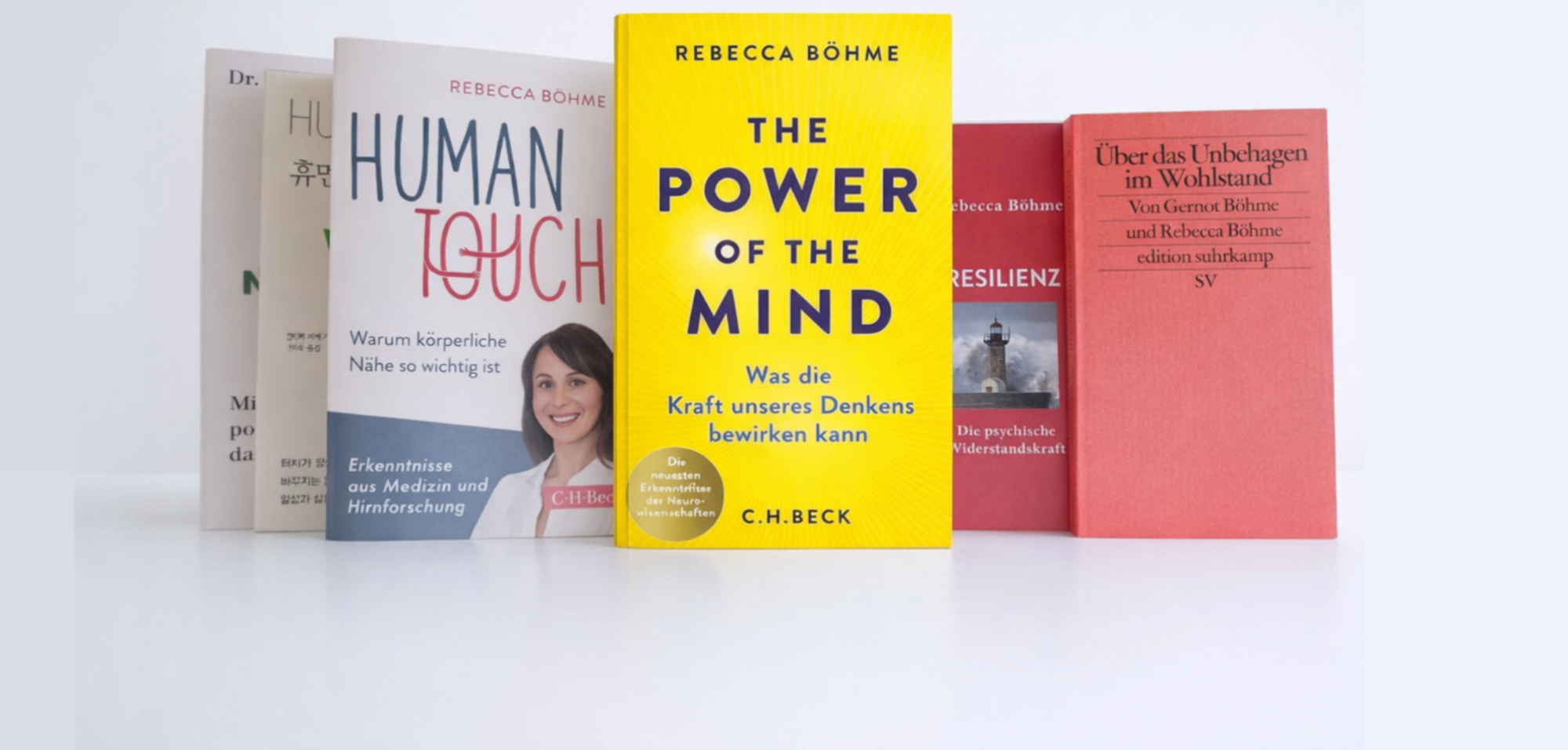
“The Power of the Mind“, C.H.Beck Verlag, in German, March 2026
“Mind your Glücksschwein“, C.H.Beck Verlag, in German, March 2022
“Über das Unbehagen im Wohlstand“, with Gernot Böhme, edition suhrkamp, May 2021
“Resilienz – Die psychische Widerstandkraft” C.H.Beck Verlag, in German, 19.9.2019
“Human Touch – Warum körperliche Nähe so wichtig ist, Erkenntnisse aus Medizin und Hirnforschung.“ C.H.Beck Verlag, in German, 25.1.2019
as editor:
Böhme/Gahling/Mersch/Nordmann/Schiemann, Philosophie als Kritik und Lebenspraxis, Herder Verlag November 2025
Bookchapters
“The Touched Body and the Experience of Self.” In: Wittmann, Strigo, Simmons (ed.), The Bodily Self, Emotion, and Subjective Time: Exploring Interoception through the Contributions of A.D. (Bud) Craig. Springer, Berlin, Heidelberg 2025. https://doi.org/10.1007/7854_2025_577
“Gibt es ein richtiges Leben im falschen? – Über Resilienz in der Leistungsgesellschaft” in Stabiler Burn-out. Sind Mensch, Gesellschaft und Natur im Zustand verstetigter Erschöpfung?, Aisthesis Verlag, 2025
“Leib-Sein und betroffene Selbstgegebenheit im Kontext der Neurodiversitätsbewegung“ in Philosophie als Kritik und Lebenspraxis, Herder Verlag 2025
“Demographische und sozioökonomische Schutzfaktoren” in Gesund bleiben in kranken Unternehmen – Springer 2023 https://doi.org/10.1007/978-3-658-39903-0, in German
“Leibliche Kommunikation und Interaktion im Analogen und Digitalen” in Analoge Kompetenzen im digitalen Zeitalter, WBG 2022, in German
In public media
“Känn dig själv på andra” in Glänta, 2/2023
“In Berührung bleiben” in Leidfaden – Fachmagazin für Krisen, Leid und Trauer, Vandenhoeck & Ruprecht Verlag, 4/2023
“Berührung – was sie besonders macht und warum sie nicht ersetzbar ist” in einfach leben, Verlag Herder, 5/2023
“Der Wert der Berührung” in Zeitschrift Konzentrative Bewegungstherapie, DAKBT&ÖAKBT, 2023
“Biopsychologie der Resilienz” in Musizieren und Üben – 4/2022
“Nähe und Berührungsmangel in Coronazeiten” in Psychotherapie in Politik und Praxis – BVVP 1/2021
Abstand bitte – Neue Züricher Zeitung, 29.10.2020
“Sensibilität” in tanz – Jahrbuch 2020
“Warum können wir uns nicht selbst kitzeln?” in Gehirn & Geist, 11/2019
“Hur vet jag vem jag är?” in Svensk Psykiatri 2, 2019
various articles in transform magazin

